
Last updated October 30, 2026
 Architectural shingles
 Metal roofing
 Tile roofing
 GAF
 Owens Corning
 Flat & low-slope
Free roof inspection with deck photos before we talk money - GAF and Owens Corning certified installation
Roof Repair Maintenance Checklist for Fountain Valley Homeowners
The most damaging rainfall event for a Fountain Valley roof often isn’t a big storm. It’s the first significant rain after a six-month dry season, hitting aged caulk and dried-out pipe boot seals that contracted all summer. The sequence is predictable: long marine-layer mornings keep surfaces damp, afternoon sun bakes them dry, Santa Ana winds blast them with dust and salt, and then a November rain arrives to exploit every crack the cycle created. Most maintenance checklists you’ll find online are written for Midwest climates with freeze-thaw cycles and autumn leaf piles. They miss what actually degrades roofs in Fountain Valley. This checklist is built around our specific annual cycle: marine-layer saturation, UV stress on flat and low-slope sections, jacaranda and palm debris loading, and sudden rain on bone-dry surfaces.
Styles & brands we work with
Quick Answer
Fountain Valley homeowners should inspect their roofs twice a year, in October before the first rains and again in March after winter storms, focusing on pipe boots, counter-flashings, ridge cap mortar, and granule loss in downspouts. The most common preventable failure is dried-out sealant around penetrations that cracks during the dry season and leaks when rain finally arrives. A simple October inspection covering these five areas will catch most problems before they become interior water damage.
Table of Contents
- Why Fountain Valley’s Climate Demands a Different Checklist
- The October Pre-Rain Checklist: 7 Tasks Before the First Storm
- Pipe Boots and Penetrations: The Most Common Leak Source in Fountain Valley
- Tile Roof Maintenance: Ridge Caps, Counter-Flashings, and Cracked Tiles
- Alligatoring on Flat and Low-Slope Sections: What to Look For
- The Granule-Loss Test: Measuring Shingle Wear Without a Ladder
- Gutter and Downspout Cadence: The Jacaranda and Palm Debris Cycle
- Which Maintenance Tasks Actually Extend Roof Life vs. Upsell Items
- Common Mistakes to Avoid
- When to Call a Professional
- Frequently Asked Questions
- The Bottom Line
Why Fountain Valley’s Climate Demands a Different Checklist
Fountain Valley sits in a coastal plain where the roof weathers in three distinct modes that repeat every year. The marine layer rolls in most mornings from late spring through early fall, saturating surfaces with salt-tinged moisture before the sun burns it off by noon. Then the dry season, from roughly May through October, subjects roofing materials to month after month of strong UV with almost no rain. Finally, the Santa Ana season brings hot, dry offshore winds that carry fine dust and grit into every seam, crevice, and sealant joint on the roof.
This cycle creates a specific failure pattern. Sealants and caulks dry out, shrink, and crack during the dry season. The marine layer keeps edges damp while the afternoon sun expands and contracts metal flashings. When the first real rain arrives in late October or November, the roof surface is at its most vulnerable: all those summer-cracked sealants are now entry points for water. A roof that shed water perfectly in March can leak by November with no visible storm damage in between.
That’s why annual fall maintenance in Fountain Valley is not optional. It’s the difference between catching a $400 pipe boot replacement in October and dealing with a $2,800 ceiling repair in December. We’ve been doing roof repair in Fountain Valley long enough to know the pattern: calls spike in the two weeks after the first real rain, and most of what we find was visible and fixable in September or October if someone had looked.
The October Pre-Rain Checklist: 7 Tasks Before the First Storm
Timing matters more than most homeowners realize. You want to complete these tasks in October, before the first significant rain. If you wait until you see water inside the house, the damage is already done. Here is the sequence that catches the failures we see most often on Fountain Valley homes.
- Inspect all pipe boots and roof penetrations. Look for cracked, brittle, or pulled-away rubber around plumbing vents, exhaust fans, and any pipe that pokes through the roof. The rubber collar shrinks during the dry season. This is the single most common leak point we repair in Fountain Valley, and it’s almost always visible from the ground with binoculars or from a ladder at the eave.
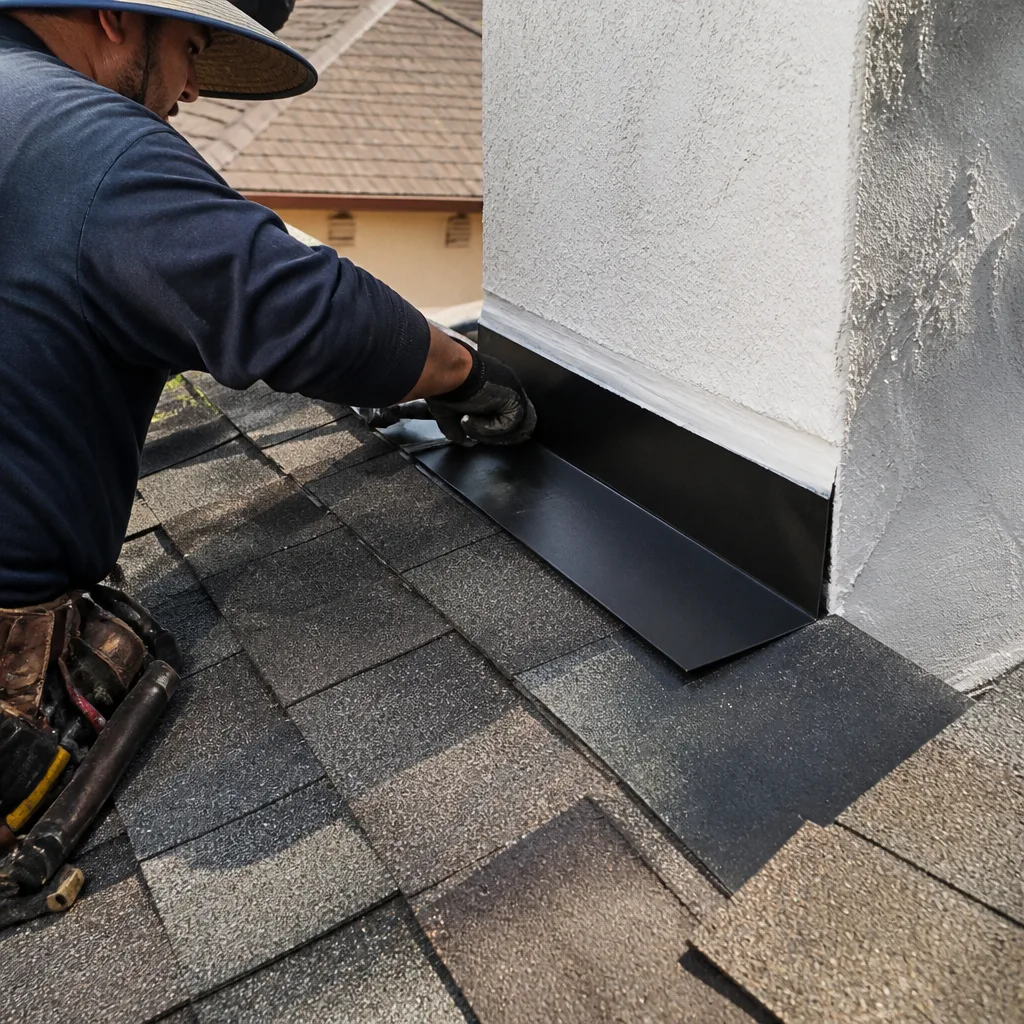
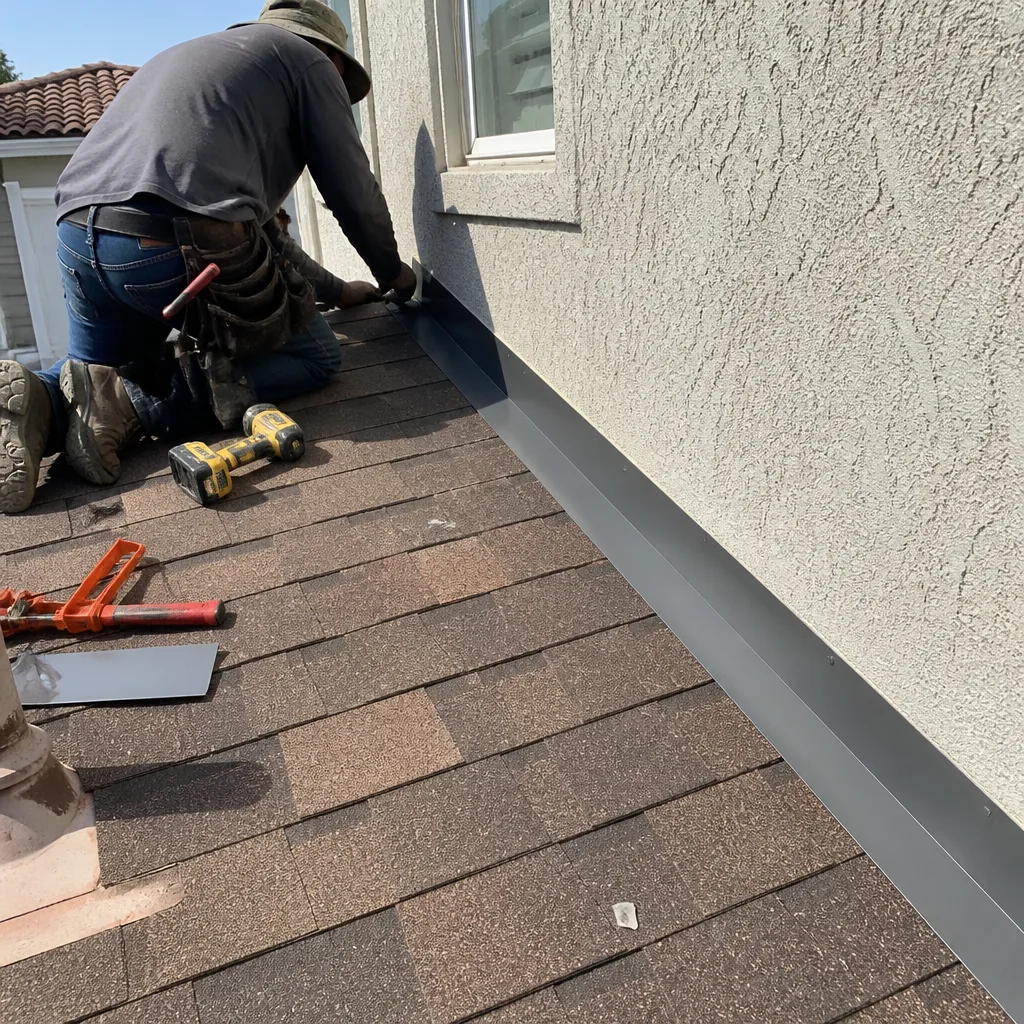
- Check all counter-flashing and step-flashing. Where the roof meets a wall, chimney, or skylight, the metal flashing should sit tight against the surface. Look for gaps, lifted edges, or missing sealant at the top of wall flashing. Santa Ana winds work sealant out of vertical joints over the summer.
- Examine sealant at all transitions. The bead where tile meets metal, where shingles meet a wall, or where two roof planes intersect should be continuous and flexible. Poke it with a chopstick or screwdriver tip. If it feels hard, cracks when pressed, or has pulled away from either surface, it needs replacement.
- Clean all gutters and downspouts. This is more than debris removal. You need to verify water actually flows through the downspout during a light test shower. A downspout blocked at the elbow will spill water against the fascia and soffit, and that water eventually finds its way under the roof edge.
- Remove debris from roof valleys and behind chimneys. Jacaranda flowers, palm fronds, and bougainvillea cuttings accumulate in these traps. Debris holds moisture against the roof surface and accelerates wear on the exact spots where water concentrates during rain.
- Check ridge caps and hip caps for cracks or loose mortar. On concrete tile roofs, the mortar holding ridge caps in place erodes from repeated wetting and drying. A loose ridge cap becomes a projectile in Santa Ana winds and leaves the ridge line exposed to direct water entry.
- Test the roof for granule loss. More on the method below, but the short version is: after the first rain, check what collects in the downspout. This tells you how much the shingle surface has deteriorated without anyone walking on the roof.
Most of these tasks take under an hour total for a single-story Fountain Valley rancher. None of them require walking on the roof. A good set of binoculars from the front and back yard covers most inspection points, and a ladder placed at the eave gets you close enough to check sealant condition at roof edges. If you’re unsure what you’re looking at, our roof inspection service in Fountain Valley walks you through every item on this list with photographs.
Pipe Boots and Penetrations: The Most Common Leak Source in Fountain Valley
If we had to name one maintenance item that prevents more Fountain Valley roof leaks than anything else, it’s the pipe boot. Every home has plumbing vents, and each vent passes through the roof with a rubber or synthetic collar that seals the gap between the pipe and the roof surface. That collar takes direct sun, marine-layer moisture, and constant temperature swings. In Fountain Valley’s dry season, the collars shrink. When rain arrives, the shrunken collar no longer forms a watertight seal around the pipe, and water wicks down the outside of the plumbing vent into the attic.
The failure is rarely dramatic. It starts as a small dark spot on the ceiling near a bathroom or kitchen, often mistaken for a plumbing leak. By the time the stain is visible on drywall, water has been working through insulation and wood for weeks. The fix at the roof level is typically straightforward: remove the old boot, install a new one, and reseal the base. But the ceiling repair below adds cost that could have been avoided with a five-minute October inspection.
Here is what to look for when examining pipe boots from the ground or an eave ladder:
- Cracks in the rubber collar. Visible from ten feet away with binoculars. If the collar shows any crack at all, it is already failing.
- Separation between the collar and the pipe. The rubber should hug the pipe tightly. If you can see daylight or a gap, water can enter.
- Brittle texture. If you can reach it from the roof edge, press the collar gently with a tool. It should flex. Hard, brittle rubber that feels like plastic needs replacement now.
- Pulled-up fasteners. The base flashing around the boot should sit flat against the roof surface with no visible nail heads above the shingle or tile surface.
We replace pipe boots as a routine roof repair in Fountain Valley throughout October and November. The job usually takes one technician under an hour, and the cost is a fraction of the interior damage a failed boot causes. If your home is over ten years old and you’ve never replaced pipe boots, assume they are at the end of their service life and plan for replacement before the first rain.
Tile Roof Maintenance: Ridge Caps, Counter-Flashings, and Cracked Tiles
Fountain Valley has a large concentration of concrete tile roofs, and tile roofs have a maintenance profile that differs significantly from shingle roofs. The tiles themselves are durable; concrete tile routinely lasts 40 to 50 years in this climate. What fails first is everything around the tiles: the mortar holding ridge caps in place, the metal flashings that transition between tile and vertical walls, and the underlayment beneath the tile that actually provides the waterproof barrier.
Ridge cap mortar. The peak of your roof is the highest point of water entry if the mortar fails. Fountain Valley’s cycle of marine-layer dampness and afternoon heat causes the mortar to erode and lose its bond over time. Walk around the house and look at the ridge line with binoculars. Missing chunks of mortar, cracked surfaces, or caps that appear shifted are all signs the ridge needs re-bedding. This is a repair we recommend doing before the winter rain season, because water that enters at the ridge travels down the underlayment and can emerge far from the actual entry point.
Counter-flashing. Where the tile roof meets a chimney, wall, or valley, metal flashing channels water away from the joint. The top edge of counter-flashing is embedded into the wall or chimney and sealed. That sealant degrades in the dry season. Look for a dark line where the flashing meets the stucco; if it’s cracked or peeling away, water will get behind the flashing. Santa Ana winds accelerate this by working the edge back and forth countless times each wind event.
Cracked or slipped tiles. Individual cracked tiles do not typically cause leaks by themselves; the underlayment below is the real water barrier. But cracked tiles expose that underlayment to accelerated UV degradation, shortening its life. Slipped tiles are a different story. A tile that has slid out of position can channel water underneath its neighbors or expose a large section of underlayment. Both conditions are worth addressing when you spot them, ideally before the first rain.
When we inspect tile roofs in Fountain Valley, the recommendation almost always comes down to repairing points of failure, not replacing the tile itself. A well-maintained concrete tile roof can outlast every other component of the house. The maintenance is in the seams, not the tile.
Alligatoring on Flat and Low-Slope Sections: What to Look For
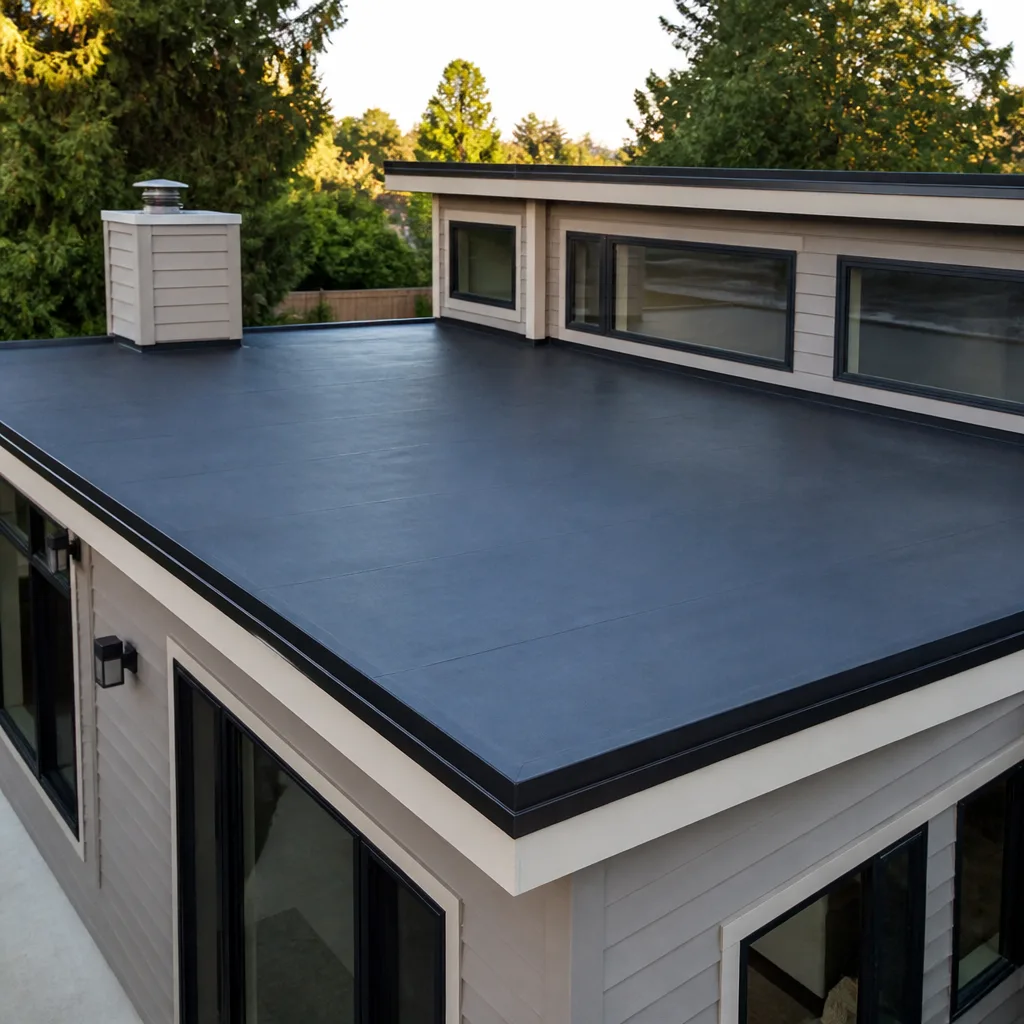
Fountain Valley ranch-style homes often have flat or low-slope sections: patio covers, carports, entry overhangs, or add-on rooms. These sections are typically covered with modified bitumen, built-up roofing, or a rolled membrane, and they respond to Fountain Valley’s climate differently than pitched shingle or tile roofs. The specific failure mode to watch for is called alligatoring.
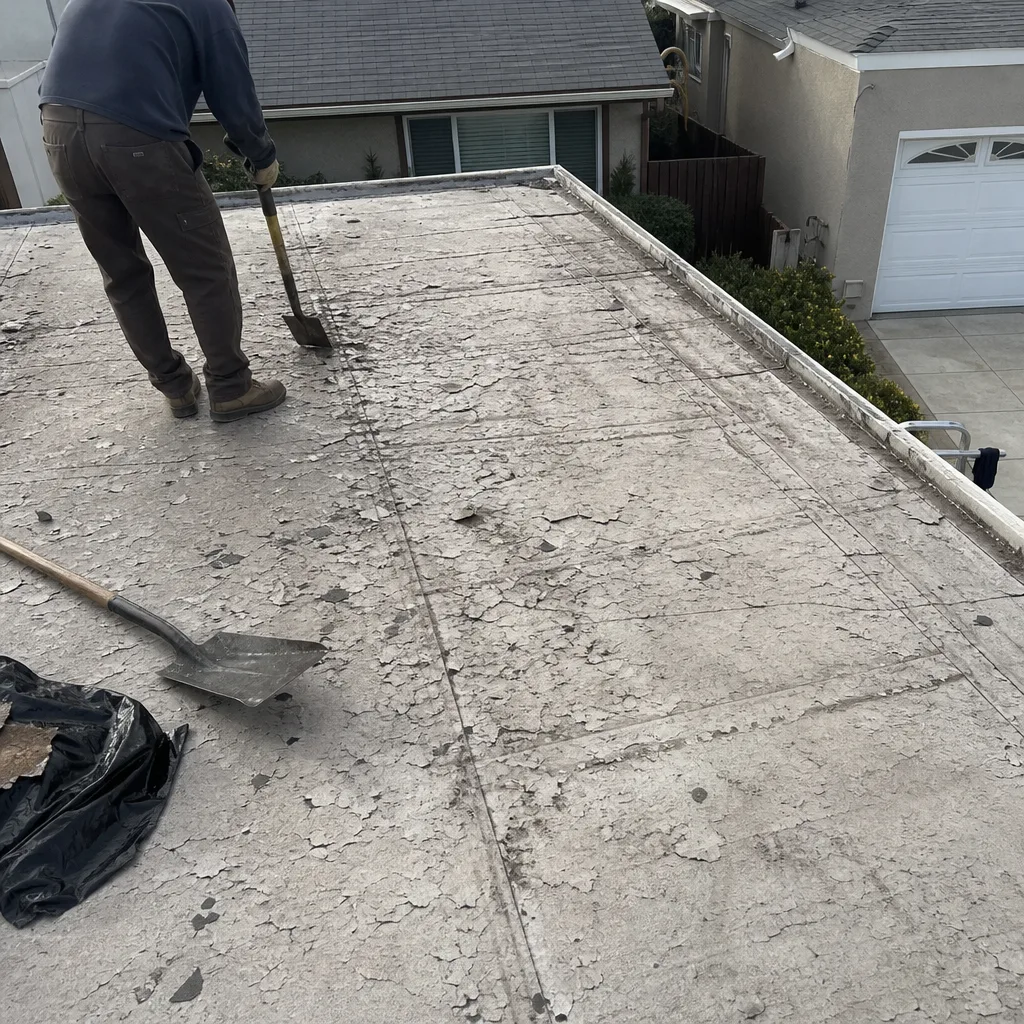
Alligatoring is a pattern of cracks that resembles the skin of an alligator. It appears on asphalt-based roof surfaces that have been exposed to years of UV without adequate protection. The surface dries out, shrinks, and splits into a web of interconnected cracks. In the early stages, alligatoring is cosmetic. In later stages, those cracks penetrate deep enough to let water reach the underlying layers, and the roof begins to fail at the points where the cracking is most severe.
The reason Fountain Valley sees more alligatoring than inland cities is the combination of marine-layer moisture and intense afternoon sun. The surface absorbs moisture overnight, expands slightly, then shrinks under direct UV during the day. That daily expansion-contraction cycle accelerates the breakdown of the asphalt’s flexibility. After five to seven summers of this, the surface begins to crack.
What to check on your flat roof section:
- Visible cracking. Get on a ladder at the roof edge and look across the surface. Fine cracks in a geometric pattern are early alligatoring. The surface still sheds water, but it no longer has reserve life.
- Bare spots or exposed fibers. If the top layer has worn through, you’ll see the reinforcement mesh or fiber backing underneath. This is advanced wear and needs a coating or patch before the wet season.
- Ponding water. Flat roofs should drain fully within 48 hours after rain. Water that sits longer accelerates alligatoring and creates a direct path for leaks. If a section ponds consistently, it has a low spot that needs correction.
- Blistering or bubbling. Small bubbles indicate trapped moisture beneath the surface layer. When a blister pops, it leaves an open hole into the roof.
Early alligatoring can often be addressed with a surface coating that restores flexibility and UV protection, extending the roof’s life by several years. Advanced alligatoring with cracking through the surface layer usually points toward replacement of that section. Either way, catching it in October is better than discovering a leak in your family room in December.
The Granule-Loss Test: Measuring Shingle Wear Without a Ladder
If your home has an asphalt shingle roof, the most useful maintenance test you can do takes about five minutes and doesn’t require getting on the roof at all. Shingle granules are the ceramic-coated mineral particles embedded in the shingle surface. They protect the asphalt below from UV degradation. As shingles age, they shed granules. Some granule loss is normal; the telltale sign of a problem is how much accumulates in your gutters and downspouts after a rain.
Here is the test:
- Wait until after the first rain of the season. The rain carries granules from the roof surface into the gutter system. The first rain is the best sample because it washes off the accumulated granule loss from the whole dry season.
- Check the downspout outlet. Look at the ground where each downspout discharges. You will see a small pile of granules. A light scattering is normal. A visible pile of granules that covers an area the size of a coffee can lid, especially if it appears darker than the surrounding soil, indicates meaningful granule loss.
- Check the gutter interior. If you can see into the gutter from the ground or a ladder, look for granules accumulating in the bottom channel. Granules look like coarse sand in colors matching your shingles.
- Look for uneven color on the shingle surface. Binoculars work for this. If some shingles look lighter or show dark patches where granules have worn away, those shingles are at the end of their functional life.
A roof that is shedding significant granules has lost much of its UV protection. The asphalt below will begin to dry out and crack, and the roof will become more vulnerable to impact from wind-blown debris. In our experience, a Fountain Valley shingle roof that shows heavy granule loss after year ten of its life is a candidate for replacement within one to three years. We’ll be honest about what we see. If you’re not sure whether the granule level in your gutter is normal, a roof inspection in Fountain Valley gives you a definitive reading with photos and a remaining-life estimate. Some jobs are full roof replacements in Fountain Valley, but many are not, and we’ll tell you the difference.
Gutter and Downspout Cadence: The Jacaranda and Palm Debris Cycle
Most national gutter maintenance advice is built around fall leaf drop, which matters less in Fountain Valley than it does in a maple forest. Our debris cycle is different, and so is our cleaning cadence. Fountain Valley streets are lined with jacaranda, Chinese elm, and a variety of palms. Each produces debris on its own schedule, and the combination creates a distinct rhythm of gutter loading.
Jacaranda trees drop their fine, fern-like foliage in late spring and early summer, not in fall. The leaves are small enough to slip through many gutter guards, but they accumulate fast and create a dense mat that blocks water flow. By the time the first rain arrives in October, that summer’s jacaranda debris has been sitting in the gutter for months, breaking down into a soggy sludge that clogs downspout elbows completely.
Palm fronds and date clusters drop throughout the year, but the wind season in September and October knocks down the majority. A single spent palm frond can span across a gutter channel and block water flow in two directions. If your home has palms within fifty feet, assume you’ll need a gutter check at least four times a year, with the critical cleaning in early October.
Our recommended minimum cadence for Fountain Valley:
- Early October: Full gutter and downspout cleaning before the first rain. This is non-negotiable.
- December: Post-first-rain check, after the first significant storm, to verify downspouts are flowing and no blockages have formed.
- June: Post-jacaranda cleanup to remove the fine leaf mat that accumulated during the bloom cycle.
- After any Santa Ana wind event over 30 mph: Wind fills gutters with dust, leaves, and loose debris in a matter of hours. A quick visual check from the ground is enough to spot problems.
Downspouts are the weak point. Most homes in Fountain Valley have downspouts that connect to drainage systems or discharge at the foundation. A blockage at the top elbow or at the connection to the underground drain can go unnoticed for months because the gutter fills slowly and overflows only during heavy rain. You’ll see water staining on the fascia or pooling at the foundation corner, and by then the damage is underway. If you’re cleaning gutters yourself, always finish by running water through each downspout to confirm flow.
Which Maintenance Tasks Actually Extend Roof Life vs. Upsell Items
Roof maintenance is a real thing that extends the life of your roof, but the truth is that some commonly sold maintenance packages are padded with tasks that don’t change outcomes. Knowing the difference matters, because Fountain Valley homeowners deserve a straight answer about where maintenance dollars actually buy additional roof years.
Tasks that genuinely extend roof life:
- Pipe boot replacement at age ten to twelve years, regardless of visible condition. This is the highest-ROI maintenance item on any shingle roof in Fountain Valley.
- Re-sealing counter-flashing and roof penetration sealant every five to seven years. Sealant fails on a predictable timeline in this climate.
- Cleaning gutters and verifying downspout flow twice per year minimum. Water backing up at the roof edge degrades the fascia and can wick under shingles or tiles.
- Re-bedding loose ridge caps when mortar erosion is visible. Loose ridge caps become wind missiles and leave the ridge line open to water entry.
- Applying a reflective coating to aging flat or low-slope sections before alligatoring advances. This resurfaces the roof and buys years of additional service.
Tasks that are often upsell items with marginal benefit:
- Annual “roof washing” or pressure washing. Tile and shingle surfaces do not benefit from power washing, which can dislodge granules and mortar. If algae staining is the concern, a specialized soft wash is appropriate, but this is a cosmetic issue, not a maintenance requirement.
- Replacing shingles for “preventive” reasons on a roof under eight years old. If the roof was installed correctly and has no storm damage, replacement shingles are solving a problem that does not exist.
- Spray-on sealants marketed as “waterproofing” for shingle roofs. Shingles are designed to shed water through layers, not through a surface-sealing film. These products can actually trap moisture and shorten roof life.
- Gutter guards of unknown quality. A properly sized and installed guard can reduce cleaning frequency, but poorly fitted products create a new layer of debris accumulation at the roof edge. Get a recommendation specific to the types of trees around your Fountain Valley home before buying.
Willowbrook Roof Repair works across seven major roofing brands, including GAF, CertainTeed, and Owens Corning. That range shapes how we think about maintenance: the right material for your home determines our recommendation, not what we happen to stock. Some shingle lines respond differently to sealant products, and some tiles need specific mortar mixes for re-bedding. Knowing the material composition of your roof matters when choosing maintenance products, and a contractor who only installs one brand may not tell you when that brand’s recommended product isn’t the right fit for your application.
Common Mistakes to Avoid
- Waiting until you see a ceiling stain to inspect the roof. By the time water shows on drywall, it has already passed through the roof deck, insulation, and framing. The roof repair is the easy part; the interior remediation is the expensive part.
- Ignoring the October inspection because “we didn’t have any problems last year.” Roof sealant fails on a predictable timeline, and the failure usually happens between one dry season and the next. Last year’s leak-free winter is a data point, not a conclusion.
- Using generic silicone caulk on roof penetrations. Roof sealants are formulated differently from bathroom caulk or window sealant. Products designed for roofing applications remain flexible across the temperature range Fountain Valley roofs experience. Using the wrong product means redoing the job in a year.
- Skipping the downspout flow check. A clean gutter is not the same as a working drainage system. The blockage at the downspout elbow is invisible from the ground and is the first point of failure in most systems.
- Walking on a clay tile roof without knowing the load points. Clay tile cracks under foot traffic if stepped on incorrectly. This is one of the few situations where hiring a professional is genuinely safer than a DIY approach, both for the person and the roof.
- Assuming a tile roof needs no maintenance. The tile portion is durable. The underlayment, flashings, and mortar are not. Tile roofs fail from the seams, not the tile, and seam failures are a direct result of skipped maintenance.
- Hiring a roofer based on price alone without asking what they will actually do. Two quotes for “roof maintenance” can include completely different scopes of work. Ask for a line-item list of what is included. We provide written line-item quotes for every job so you know exactly what you’re paying for before work begins.
When to Call a Professional
Some maintenance items belong on the DIY list. Others cross the line into safety and expertise territory. Call a professional when: you see water stains on the ceiling or walls; you find missing tiles or shingles after a Santa Ana event; your flat roof surface shows advanced alligatoring or blistering; you notice granules accumulating in downspouts at levels that suggest active shingle wear; or any inspection reveals problems at height that require walking the roof surface itself. Roof work carries real risk, and a fall from even a single-story Fountain Valley rancher can be life-changing. We’ve seen what happens when well-meaning homeowners attempt repairs beyond their equipment and training. If you’re unsure whether a problem is serious, the appointment costs nothing: Willowbrook Roof Repair offers free estimates in Fountain Valley. Call (866) 860-9404 and we’ll take a look, tell you what we see, and give you a straight answer about what needs to happen and why. Roofing is the only thing we do, and from a single damaged section to a full tear-off and replacement, one call covers the entire job.
Frequently Asked Questions
Twice a year is the right cadence for Fountain Valley homes: once in October before the first rains, and once in March after the winter storm season. Roof sealants begin failing during the summer dry season, so the October inspection is the one that catches problems before they leak. A March inspection covers any damage from winter storms and Santa Ana wind events.
Routine maintenance items like pipe boot replacement typically cost between $200 and $450 per boot depending on access and roof type, while re-sealing a section of counter-flashing runs $150 to $400. Gutter cleaning on a single-story home ranges from $90 to $180. Full re-sealing of all penetrations usually lands between $350 and $800. Call (866) 860-9404 for an exact quote on your roof; estimates are free and we’ll walk you through what your specific roof actually needs.
No. We work from written line-item quotes with fixed pricing, and we do not issue change orders without discussing the reason with you first. The price we quote is the price you pay unless you ask us to add scope.
Most individual maintenance items, like pipe boot replacement or sealant re-application, take under two hours. A full maintenance package covering all penetrations, flashings, and gutter verification typically takes half a day for a single-story Fountain Valley home. We’ll give you a time estimate with your quote, and we call ahead to confirm when we’re on the way.
Most maintenance repairs do not require permits under Fountain Valley’s building codes. Larger repairs that involve structural decking work or full roof replacement do require permitting, and we handle that process from start to finish, including the inspections. You’ll know before work begins whether your job needs a permit.
Yes. We repair and maintain roofs installed by other contractors, and we work on roofs with materials from all seven major manufacturers we carry: GAF, CertainTeed, Owens Corning, IKO, Atlas, Tamko, and Boral. Because we are material-agnostic, we can match repair materials to your existing roof system rather than forcing a substitution from a single brand line.
It depends on what the inspection finds. If the roof surface shows granule loss beyond normal wear, sealant failure at multiple points, or advanced alligatoring on flat sections, spending on maintenance may not be the best use of your budget. We will tell you honestly if your roof is at the point where roof replacement in Fountain Valley is the more cost-effective choice over the next three to five years. That’s a conversation we have with Fountain Valley homeowners every week.
The Bottom Line
Fountain Valley roofs do not fail randomly. They fail on a schedule that tracks the local climate cycle: summer dry-season sealant shrinkage, October wind-driven debris loading, and November rain that finds every crack the dry season created. The maintenance that matters is timed to that cycle, not to a generic seasonal checklist from a different climate. Check pipe boots, flashings, and ridge caps in October. Run the granule test after the first rain. Clean gutters on the jacaranda and palm rhythm, not a leaf-dropping calendar. And know which maintenance tasks actually buy roof years versus which ones are upsell filler. The roof over your head is too important to guess about. Start with an honest inspection. You’ll know exactly what needs to be done, and why, before any work begins.
Willowbrook Roof Repair home is your starting point for any of these services, or call (866) 860-9404 to schedule your free estimate.
Written by the team at Willowbrook Roof Repair, serving Fountain Valley since 2012.
See the difference
 Before
 After
 Before
 After
 Before
 After