
Last updated October 30, 2026
 Metal roofing
 Architectural shingles
 Tile roofing
 GAF
 Owens Corning
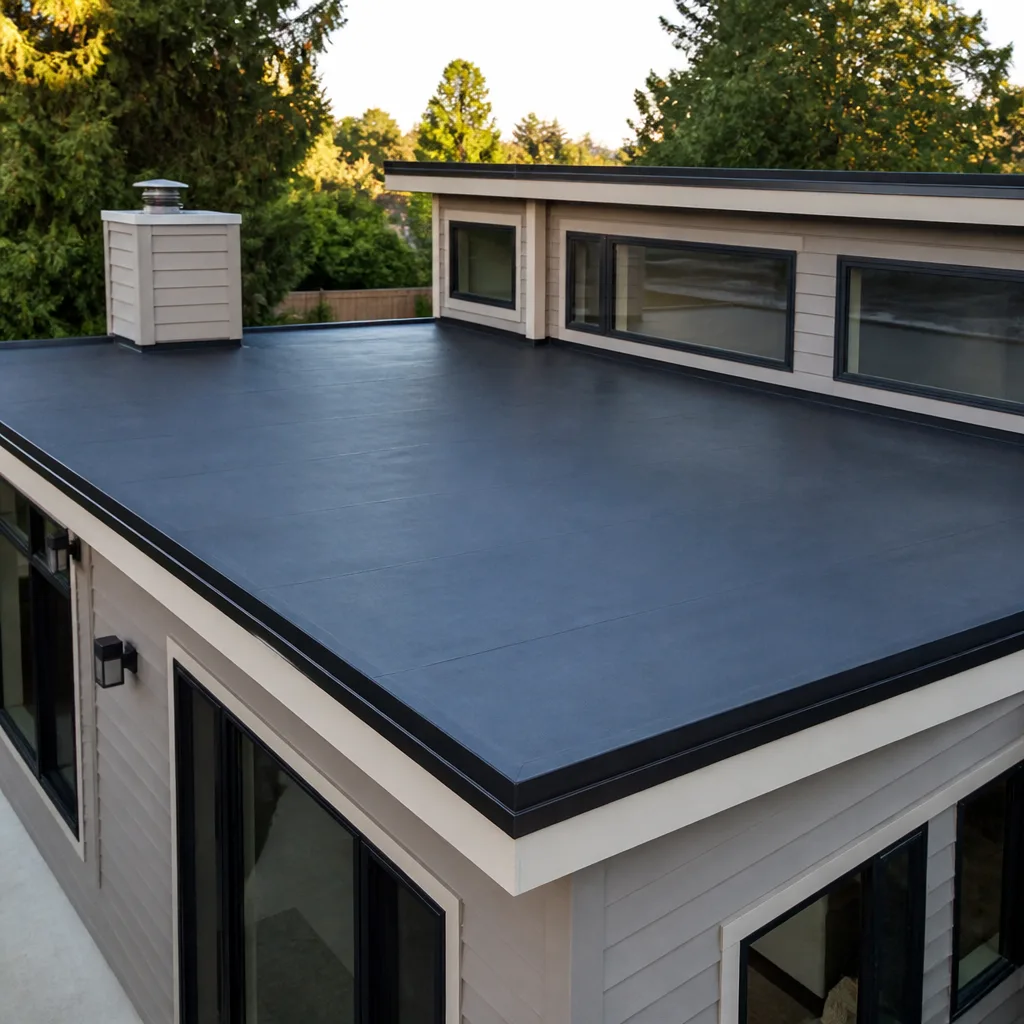 Flat & low-slope
Free roof inspection with deck photos before we talk money - GAF and Owens Corning certified installation
Roofing Warning Signs: A Fountain Valley Homeowner’s Reference Guide
A cracked concrete tile on a Fountain Valley roof is rarely the actual leak source. The real problem sits beneath it: a layer of underlayment that was probably installed when the house was built, has been baking in Orange County sun for two decades, and now disintegrates at the touch. Replacing the tile while leaving that failing felt in place is the single most common reason tile-roof repairs in Fountain Valley fail within two rainy seasons. This guide covers the early-stage signals most homeowners dismiss or misattribute, with specific attention to the concrete tile, clay tile, and low-slope hybrid roofs that dominate our local housing stock. For a broader overview, see The Complete Guide to Roofing in Fountain Valley. By the end, you’ll know what needs watching, what’s cosmetic, and what deserves a phone call before the next winter rain.
Quick Answer
The most important roof warning signs for Fountain Valley homeowners are stains on ceiling drywall that appear away from windows, granule buildup in gutters on shingle sections, white mineral streaking on tile that reappears after cleaning, looseness where roof flashing meets stucco walls, and any blistering or seam separation on flat roof membranes. Early-stage failures often show up as subtle discoloration or granule loss months before an active leak appears. Catching these signals during an Roof Inspection in Fountain Valley costs far less than repairing water damage to interior framing.
Styles & brands we work with
Table of Contents
- Efflorescence on Tile: Cosmetic Issue or Moisture Warning?
- Condensation vs. Active Leak: A Fountain Valley Misdiagnosis
- Flat Roof Warning Signs You Can See from the Edge
- Granule Accumulation in Gutters: What It Actually Tells You
- Flashing and Stucco: The Highest-Probability Leak Point
- Underlayment: The Hidden Layer That Determines Repair Success
- Repair vs. Replacement: How to Read the Signals Objectively
- Common Mistakes to Avoid
- When to Call a Professional
- Frequently Asked Questions
1. Efflorescence on Tile: Cosmetic Issue or Moisture Warning?
White chalky streaks running down concrete or clay tiles are called efflorescence. It happens when water moves through the tile’s mineral body and carries dissolved salts to the surface, where the water evaporates and leaves the salt behind. On older Fountain Valley homes, you’ll see it concentrated near mortar joints, especially on hips, ridges, and where tiles meet walls.
The first time you see it, efflorescence is usually cosmetic. The tile itself is doing exactly what it was designed to do: absorbing moisture and shedding it. But there’s a meaningful difference between one-time staining and a recurring signal.
Here’s how to read what you’re seeing:
- Light, even, dusty coating over wide areas: Typically cosmetic. This appears after the first heavy rain of the season and weathers away within a few weeks.
- Dense white buildup concentrated at mortar joints: This indicates chronic moisture moving through the joint itself. The mortar has likely cracked or separated from the tile, and water is traveling through the gap rather than down the tile face.
- Crystalline or crusty texture that reappears after cleaning: The tile is absorbing water repeatedly. This is no longer cosmetic. Water is getting somewhere it should not be, and the salt is the visible trace of that movement.
- White staining paired with dark tile edges or soft mortar: You’re looking at active moisture saturation. The dark edges are the tile body holding water; the soft mortar is in the early stages of erosion.
On Fountain Valley’s older tile roofs, many of which date to the original housing boom of the 1960s and 70s, the mortar at hips and ridges has been exposed to marine air and sun for 50-plus years. That’s a long service life for a material that was never intended to be structural. When efflorescence keeps returning in the same spots, the odds are high that the underlayment below those joints is also wet and failing.
2. Condensation vs. Active Leak: A Fountain Valley Misdiagnosis
Fountain Valley sits three miles from the Pacific. Marine air rolls in most evenings, and homes with older insulation or single-pane windows routinely experience interior condensation from December through March. That leads to a specific and costly misdiagnosis: a homeowner sees a water stain on a bedroom ceiling, calls a roofer, gets told the roof is leaking, and pays for a repair that never addresses the actual cause.
Here’s how to tell the difference before you spend money:
- Location of the stain: Condensation stains appear on ceilings below cold attic surfaces, often near exterior walls, around recessed light fixtures, or along ceiling joists. Active roof leaks follow a path from a specific penetration or damaged area and typically appear below that point.
- Shape and color: Condensation staining is typically broad, faint, and irregular, with soft edges. A roof leak usually produces a defined stain with a darker center, often in a ring or drip-line pattern.
- Timing relative to weather: Condensation staining appears during cool nights with high humidity, regardless of whether it rained that week. A roof leak worsens during or immediately after rain.
- Attic evidence: Go into the attic with a flashlight on a cool morning. If you see water beading on the underside of the roof deck or on exposed nails, that’s condensation, not a leak. If you see a dark, saturated path through the decking leading to a specific point, that’s a leak.
This distinction matters because Fountain Valley’s coastal climate creates the exact conditions for condensation that inland Orange County cities don’t experience with the same frequency. A competent roofer will check the attic before recommending a repair. If the person you call reaches for a bid sheet before they look at the underside of the roof, get a second opinion. We’ve walked into more than a few Fountain Valley homes where the previous roofer “fixed” a leak that never existed.
3. Flat Roof Warning Signs You Can See from the Edge
Fountain Valley has a significant number of mid-century homes with flat or low-slope roof sections, particularly in neighborhoods west of the 405 where the original tract housing included modern-style designs. Flat roofs fail differently than pitched roofs, and the early warnings are visible from the ground or a ladder at the roof edge, no walking on the membrane required.
The materials on most residential flat roofs in Fountain Valley are either built-up roofing (layers of asphalt and felt topped with gravel) or modified bitumen (a rolled membrane with a granulated or smooth surface). Single-ply membranes like TPO or PVC also appear on newer installations. Each fails in recognizable ways.
What to look for:
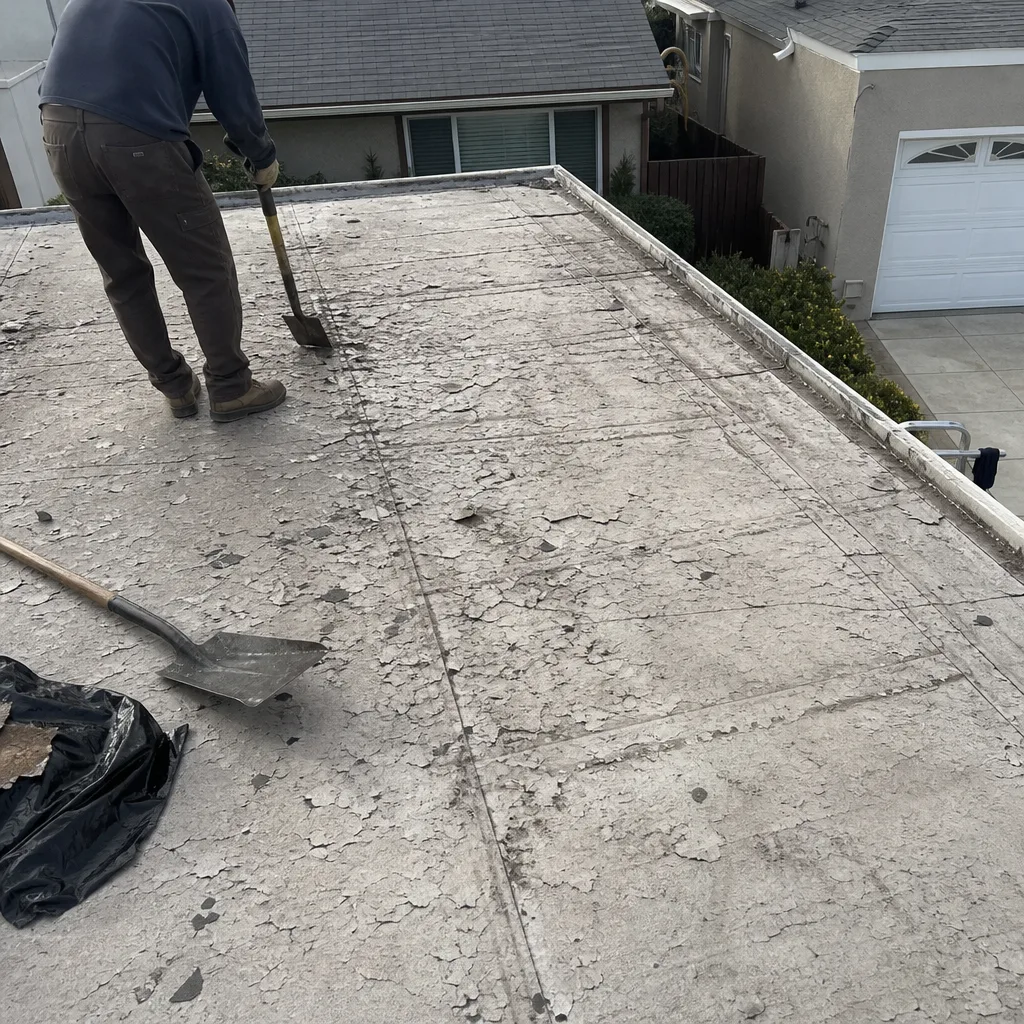
- Blistering: Raised bubbles in the membrane surface, ranging from the size of a quarter to several inches across. Blisters mean moisture or air is trapped between membrane layers. Left alone, they crack and become direct entry points for water.
- Seam separation: On rolled membranes, the seams where two sheets overlap are the first place adhesion fails. From the roof edge, look for lifting or curling at sheet edges, especially near drains and parapet walls.
- Drain ring rust: The metal rings around flat roof drains corrode over time, and the rust is visible from a ladder. Rust at the ring often signals that water has been ponding there longer than it should, which points to drainage problems or a sagging roof structure.
- Ponding water that persists 48 hours after rain: Flat roofs are designed to shed water, not hold it. Water that sits for two or more days accelerates membrane deterioration and adds weight stress to the roof deck.
- Exposed felt or fiberglass: On gravel-surfaced built-up roofs, areas where the gravel has worn away leave the asphalt and felt underneath exposed to UV. The surface takes on a bald, shiny look. That’s accelerated aging in progress.
None of these require walking the roof surface to identify. A ladder at the roof edge or even a careful look from a second-story window will reveal most of them. If you see any combination of these signals on a flat section, the smart move is a Roof Repair in Fountain Valley assessment before the next heavy rain.
4. Granule Accumulation in Gutters: What It Actually Tells You
Asphalt shingles shed granules for two reasons: normal aging and manufacturing or installation defects. The distinction matters because one is expected and the other is a warranty issue.
Granules are the ceramic-coated mineral layer that protects the asphalt core of a shingle from UV degradation. As shingles age, they lose granules at a slow, steady rate. A small accumulation in the gutters after a rain is normal, especially for a roof that’s been in Fountain Valley’s sun for a decade or more.
What the amount tells you:
- Light, even sprinkling across the gutter: Normal weathering. Note it and move on.
- Heavy accumulation, visible piles at downspout openings: The shingles are shedding at an accelerated rate. This is either advanced age or a defect.
- Granules mixed with visible shingle fragments or a sandpaper texture on exposed shingle edges: The shingles are in terminal decline. Replacement is on the horizon regardless of what the original install date suggests.
- Granule loss concentrated in patches, not evenly distributed: This can indicate a manufacturing defect affecting specific shingle bundles. If the roof is under warranty and you have the original documentation, this may be claimable.
The critical calibration: compare the granule signal against the roof’s known install date. If you have a 25-year architectural shingle roof that was installed eight years ago and you’re seeing heavy granule accumulation, that’s abnormal. Something is wrong. If the roof is 22 years old, heavy granule loss is simply the material reaching the end of its designed life.
One more thing specific to Fountain Valley: homes with both tile and shingle sections, usually where a room addition or patio cover was built after the original construction, will show different aging rates on each material. The tile section may look fine while the shingle section is near failure. Do not let the overall condition of the larger roof area mask the condition of the smaller one.
When we replace shingle roofs in Fountain Valley, we work across brands like CertainTeed, Owens Corning, and Atlas so the material recommendation follows the homeowner’s roof and budget, not a supplier agreement. For help selecting materials, read our Choosing the Right Roofing Brand: A Buyer’s Guide for Fountain Valley. The granule reading tells us whether replacement is urgent or something that can be planned over the next season or two.
5. Flashing and Stucco: The Highest-Probability Leak Point
Fountain Valley’s housing stock is overwhelmingly stucco exterior. That matters for roofing because the junction where a sloped roof meets a stucco wall is a flashing detail that fails more reliably than any other point on a Southern California home.
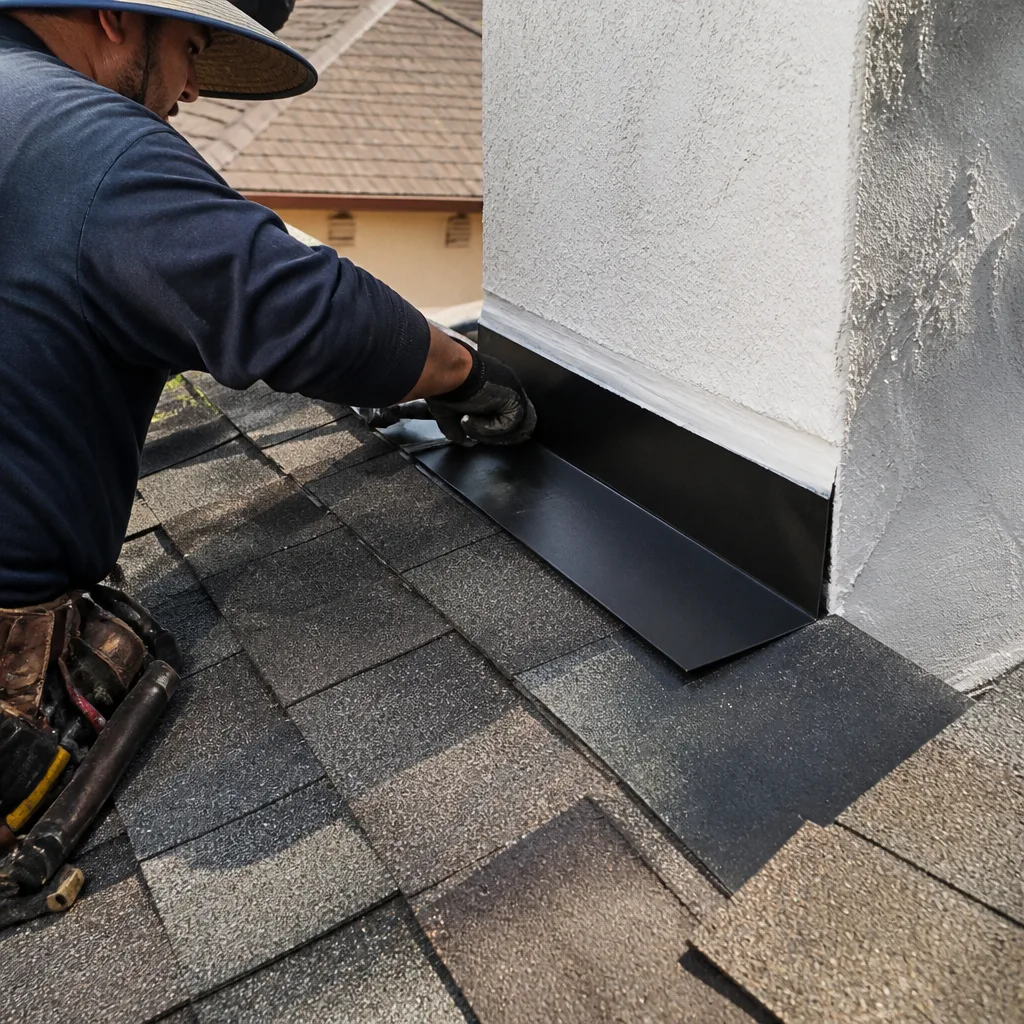
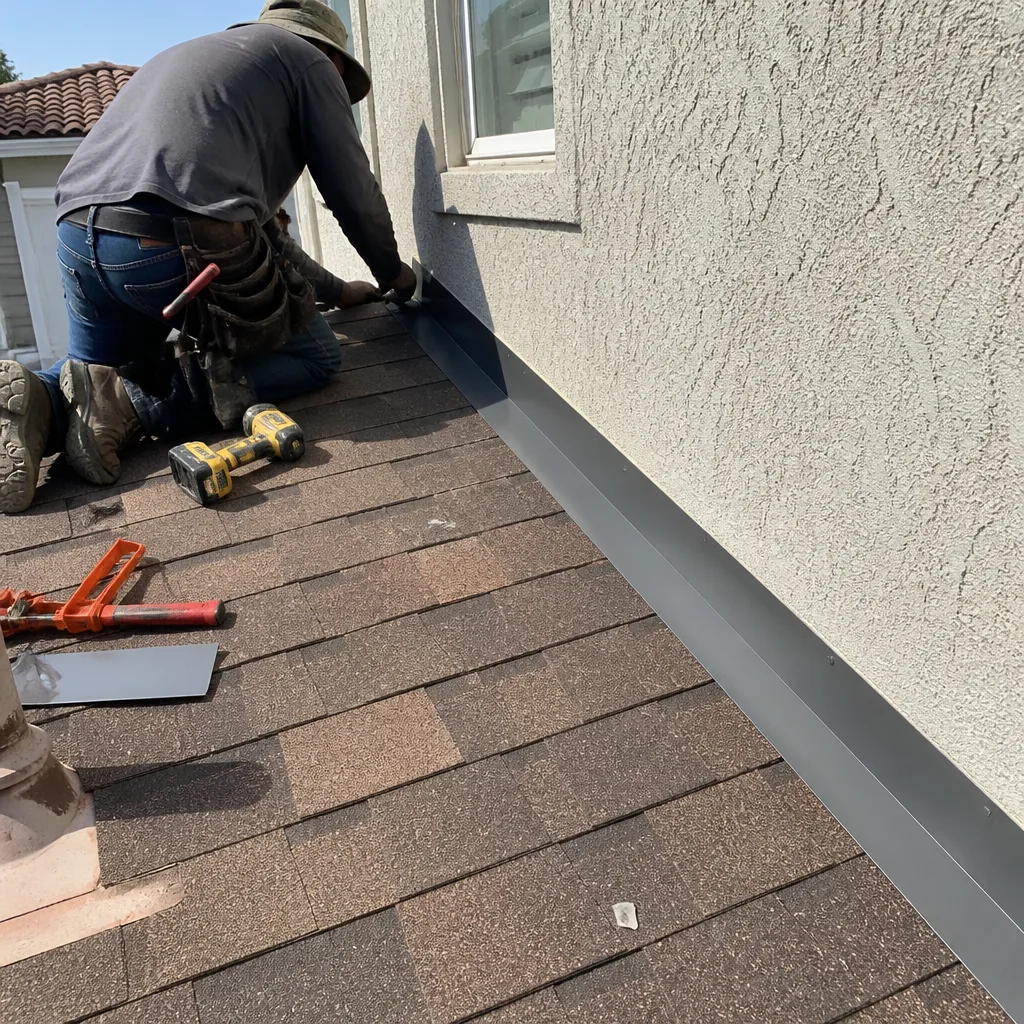
Here’s what happens. Step flashing, the zigzag metal pieces that weave between shingles or tiles and tuck behind the wall surface, is installed at the base of the stucco. Over decades, the stucco itself cracks at that junction. The crack opens a path for water to run behind the flashing. The flashing may still be in place and undamaged, but water is getting past it anyway through the failed stucco above.
What to look for at every stucco-to-roof junction on your home:
- A horizontal crack line running along the base of the stucco where it meets the roof: This is the single most common entry point for water on Fountain Valley roofs. It’s visible from the ground with a good eye or a pair of binoculars.
- Stucco that has pulled slightly away from the roof surface, showing a gap: The stucco has lost adhesion to the wall substrate and is lifting. Water enters the gap and travels behind the flashing.
- Dark staining or efflorescence on the stucco surface just above the roof line: The wall itself is wicking moisture from the failed junction.
- Rust at the base of the flashing or fasteners: Water has been sitting there long enough to corrode metal. This is a late-stage signal.
- Caulking that has dried, cracked, or pulled away from either surface: Previous repair attempts using caulk almost always fail within a few seasons. Caulk is not a flashing replacement.
The fix at stucco junctions is not simply re-caulking. Proper repair requires cutting into the stucco base, installing or replacing the step flashing and counter-flashing, then patching the stucco so the new flashing integrates with the wall. That’s a roofing repair, not a handyman caulk job, and it’s the kind of work we handle regularly across Fountain Valley homes from the tract-era original builds to the newer custom constructions.
6. Underlayment: The Hidden Layer That Determines Repair Success
Tile roofs in Fountain Valley have two layers. The visible tile is the weathering surface: it sheds water, protects the structure from UV, and gives the home its appearance. The hidden layer underneath, the underlayment, is the actual waterproofing. Most homeowners never see it, and many roofers never explain it.
Here’s why it matters. Concrete and clay tiles are not waterproof. They are water-shedding. Small amounts of water get past the tile at joints, cracks, and overlaps. The underlayment catches that water and directs it down to the eaves. When the underlayment is healthy, the roof is waterproof. When it fails, the tile above it can look perfectly fine while water moves through the roof system unnoticed.
Typical underlayment service life in Fountain Valley’s climate runs 20 to 30 years for the traditional asphalt-saturated felt installed on most original homes. The newer synthetic underlayments used on recent replacements carry longer warranties and handle UV exposure better during construction, but even those have limits.
Signals that underlayment is failing, even when tile looks fine:
- Recurring leaks that move around: A leak that appears in different ceiling locations after different storms suggests water is getting past the tile in multiple places and traveling along the failing underlayment before finding a way through the deck.
- Tiles that look fine but feel loose or shift under foot pressure: The fasteners may still be holding, but the underlayment underneath has degraded and the tile system has lost its secondary support.
- Visible underlayment at the eaves showing tears, cracking, or brittleness: From a ladder at the roof edge, you can often see a few inches of underlayment extending past the tile. If it looks like old, cracked paper, it’s likely doing the same thing across the entire roof field.
- Black streaking on the underside of the roof deck visible from the attic: That’s water that made it through the underlayment and ran along the wood decking. The streaking is the trail.
This is the reason we’re direct about a counterintuitive truth: on many Fountain Valley tile roofs, the tile is not the problem and replacing tile is not the fix. The honest answer is often an underlayment replacement, which for a tile roof means lifting the tile, replacing the felt, and resetting the original tile if it’s still in good condition. That’s a Roof Replacement in Fountain Valley in scope, even when the tile stays. Understanding this distinction before you start comparing bids will save you from spending money on a repair that fails on schedule.
7. Repair vs. Replacement: How to Read the Signals Objectively
Most homeowners don’t need a roofer to tell them whether to repair or replace. They need a roofer who will walk them through the reasoning in plain language so they can verify it themselves. Here’s the decision framework we use, written for a homeowner to follow. For year-round maintenance tips, see our Seasonal Roofing Care for Fountain Valley: Year-Round Homeowner’s Guide.
Lean toward repair when:
- Damage is localized to one or two identifiable points: a single cracked tile, one failed flashing junction, one seam separation on a flat section.
- The roof is under 15 years old and the underlayment, where visible at the eaves, is still pliable and intact.
- Granule loss on shingles is light and consistent with the roof’s age.
- There is no evidence of water reaching the attic or interior structure.
- The issue is mechanical rather than material: a loose tile, a slipped shingle, a separated seam.
Lean toward replacement when:
- Damage is distributed across multiple areas: granule loss over more than 30% of a shingle field, cracked tiles spread across several roof faces, or seam separation on multiple flat roof sections.
- The underlayment at the eaves is brittle, cracked, or disintegrating.
- Leaks have recurred after previous repairs, especially if the repair addressed the visible problem but not the underlayment.
- The roof is within 5 years of its expected service life and showing accelerated aging signals.
- Multiple flashing junctions show the same failure pattern, indicating systemic rather than localized issues.
In most cases, the roof tells you which answer it needs. The trick is looking at the signals that matter rather than the ones that are obvious. A few cracked tiles is a repair. Cracked tiles plus failing underlayment plus efflorescence at every hip is a replacement dressed up as a repair. The honest assessment comes from looking at all three layers: the visible surface, the underlayment, and the condition of the flashing junctions.
Common Mistakes to Avoid
- Replacing tile without inspecting the underlayment. The tile is the cosmetic layer. If the underlayment underneath is 25 years old and failing, the new tile won’t stop the leak. We see this mistake repeated across Fountain Valley every winter.
- Chasing condensation stains with roofing repairs. Marine-climate condensation produces ceiling stains that mimic leaks. A roofer who doesn’t check the attic before writing a bid is guessing. An attic inspection takes ten minutes and separates a roofing problem from an insulation or ventilation problem.
- Caulking stucco-to-roof junctions. Caulk at flashing junctions lasts a season or two in Fountain Valley’s sun and salt air. The fix is proper flashing integration, not a bead of sealant over a cracked joint.
- Ignoring granule accumulation because “the roof looks fine from the street.” Curb appeal is not a roof condition assessment. The gutters tell you more about shingle health than anything visible from the sidewalk.
- Dismissing efflorescence as permanent but harmless staining. Efflorescence that stays localized and recurs after cleaning indicates water movement. The staining itself is harmless; the moisture path behind it may not be.
- Walking a tile roof to inspect it. Concrete tile cracks under foot traffic, especially older tile that’s been baking in California sun for decades. Inspection from the eaves, the ladder, and the attic gives you the data you need without creating new damage.
- Delaying a roof inspection until the next rain. Roof problems don’t announce themselves politely. The dry months in Fountain Valley are the right time for inspection and repair work, before winter water finds the gaps.
When to Call a Professional
Call a roofer when you see efflorescence that recurs in the same spots, granule accumulation heavier than the roof’s age suggests, stains on ceilings that appear after rain, or any of the flat-roof signals described above. Also call after any significant wind event if you find tile fragments or shingle pieces in the yard. A roof inspection that identifies failing underlayment early can be the difference between a few hundred dollars of targeted repair and a complete replacement with interior water damage to address on top of it. Willowbrook Roof Repair offers free estimates in Fountain Valley. Call (866) 860-9404 and we’ll give you an honest read on what the roof is telling you.
Frequently Asked Questions
A standard residential roof inspection in Fountain Valley typically runs between $150 and $400 depending on roof complexity and access, though many roofing companies including ours offer free estimates for homeowners who are evaluating specific problems. The inspection fee, when charged, covers a full assessment of tile or shingle condition, underlayment health where visible, flashing junctions, and flat roof sections. Call (866) 860-9404 to schedule your free estimate.
Underlayment failure shows up as recurring leaks that move around, tiles that stay in place but feel loose, brittle or cracked felt visible at the eaves from a ladder, black streaking on the underside of the roof deck in the attic, and efflorescence that persists at hips and ridges after cleaning. If your Fountain Valley home’s roof is over 25 years old and showing any of these signals, the underlayment likely needs replacement even if the tile looks fine.
A ceiling stain that appears without rain is most likely condensation from Fountain Valley’s marine climate. Cool, moist air meets cold ceiling surfaces in rooms over unconditioned attics, especially around recessed lights and exterior walls, and produces broad, faint stains. Check the attic on a cool morning: water beading on the underside of the decking is condensation, while a saturated path through the decking indicates an active leak.
The concrete and clay tile itself can last 50 years or more in Fountain Valley’s climate, but the underlayment beneath it typically lasts 20 to 30 years. This mismatch creates the most common scenario we see: tile that still looks good on a roof whose waterproofing failed a decade ago. The effective service life of a tile roof is determined by the underlayment, not the tile.
Not necessarily. Light, even efflorescence that appears after rain and weathers away is usually cosmetic. Dense white buildup concentrated at mortar joints that recurs after cleaning signals chronic moisture movement through cracked mortar, which can indicate underlayment problems below. A closer inspection of the joints and the attic beneath them tells you which scenario you have.
Repair is the right call when damage is localized to specific points and the underlayment is intact. Replacement is indicated when damage is distributed across multiple areas, the underlayment is failing, leaks have recurred after previous repairs, or the roof is within five years of its expected life and showing accelerated aging. An honest inspection will tell you which answer fits your roof. Call (866) 860-9404 and we’ll walk you through what we see and why.
The Bottom Line
Most roof failures in Fountain Valley are visible months before they become active leaks, if you know which signals matter. The tile is rarely the problem. The underlayment is usually the problem. The stucco-to-roof junction is the highest-probability leak point on most local homes. Condensation stains and condensation leaks are different things that require different responses. And granule accumulation in gutters is a more reliable age indicator than anything you can see from the street. None of this requires specialized knowledge to observe. It requires knowing what to look at. Start at the eaves, check the attic, watch the gutters, and when something doesn’t add up, get a roofer who will explain the roof’s condition in plain terms before any work begins. We work across seven major roofing brands, including CertainTeed, Owens Corning, IKO, Atlas, and more, so our material recommendation follows your roof and your budget, not a supplier agreement. From a single flashing repair to a full underlayment replacement, Willowbrook Roof Repair home covers the full roofing lifecycle for Fountain Valley homeowners.
Written by the team at Willowbrook Roof Repair, serving Fountain Valley since 2012. Browse more guides & resources on our blog.
See the difference
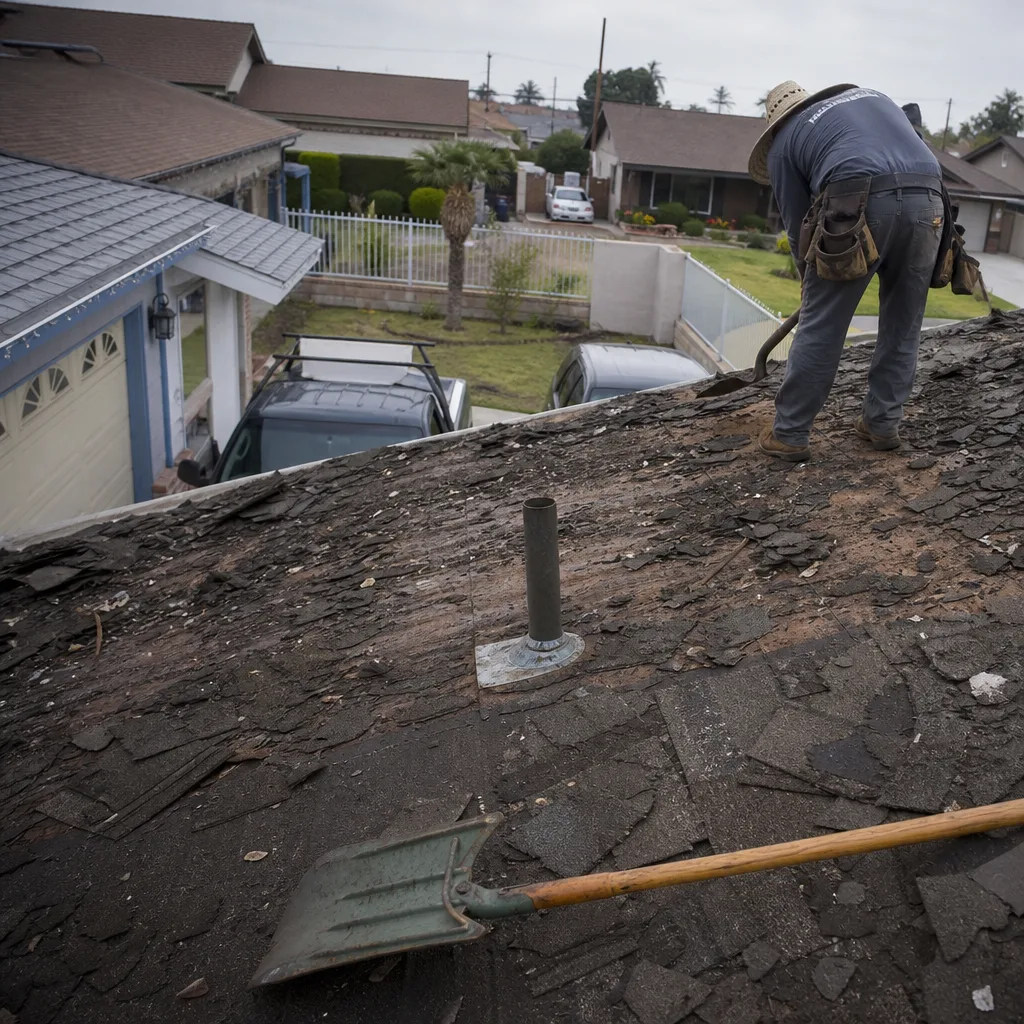 Before
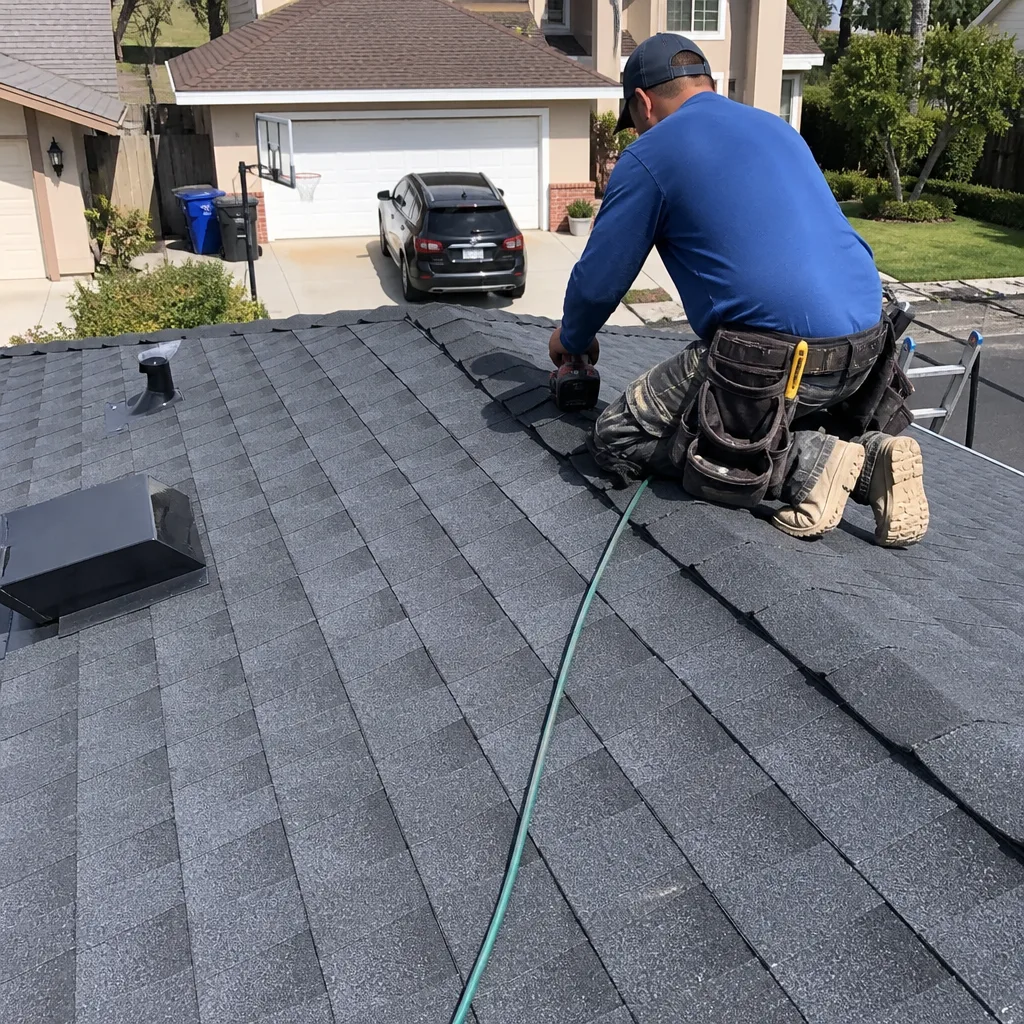 After
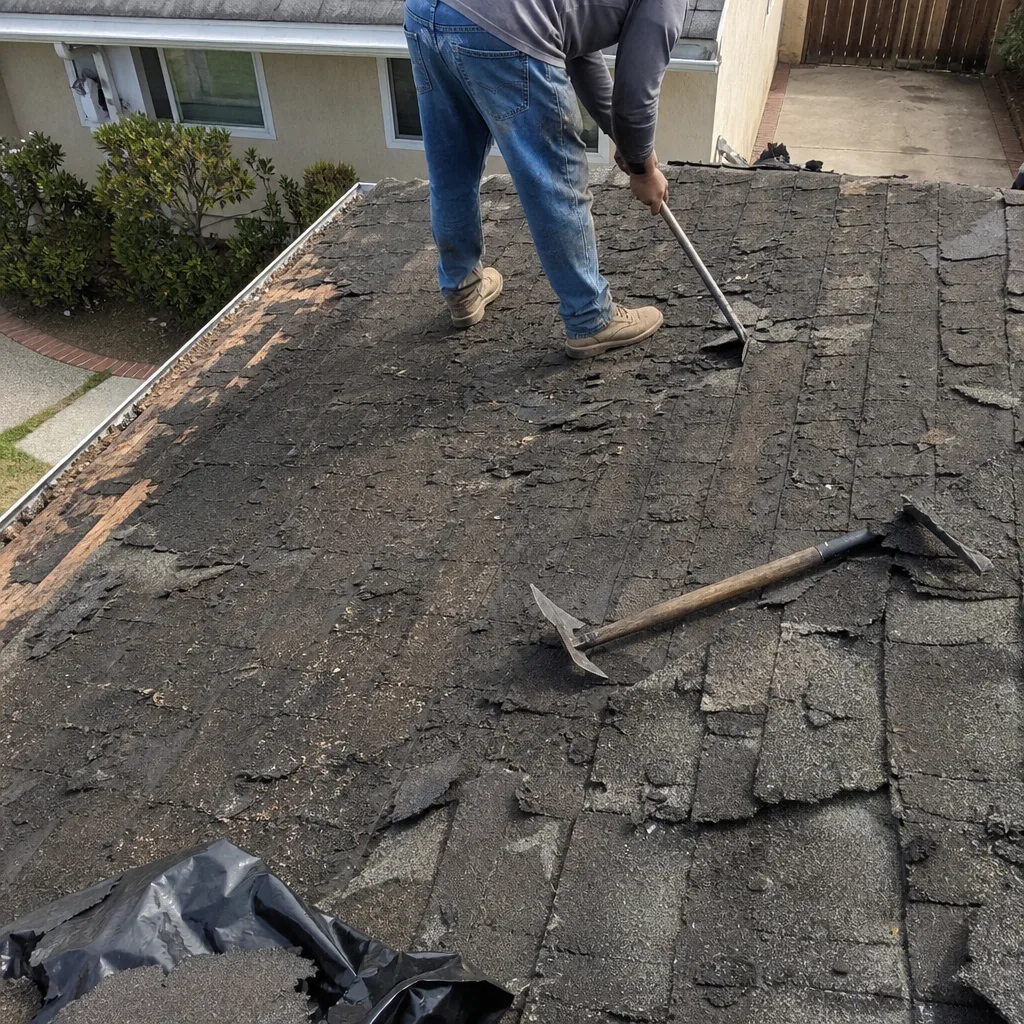 Before
 After
 Before
 After